 IT vs Management: Which has a Better Scope in Nepal?
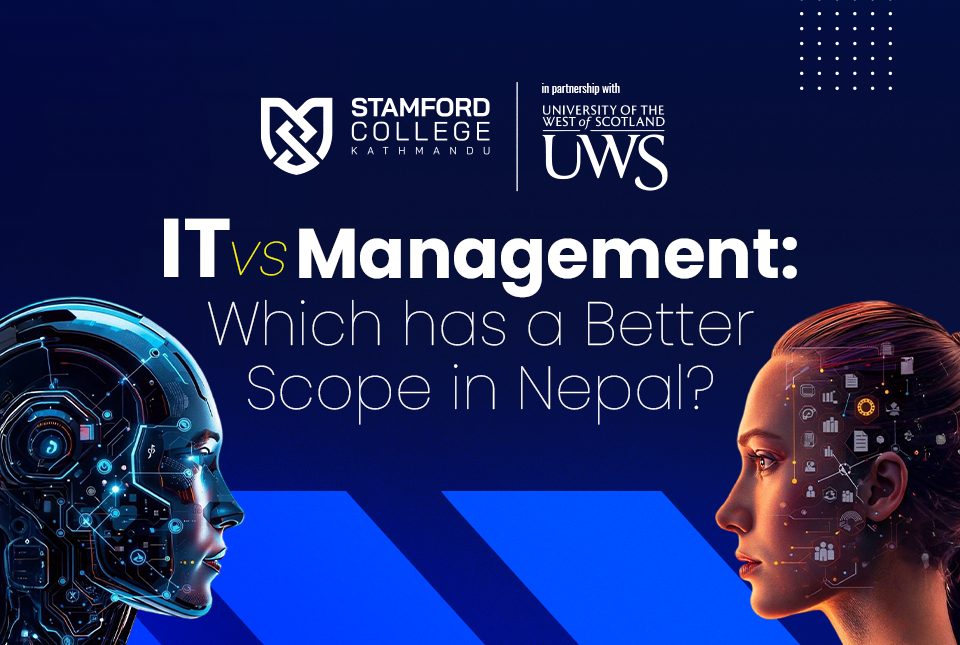
IT vs Management: Which has a Better Scope in Nepal?
Choosing between Information Technology (IT) and Management is one of the most common dilemmas for Nepali students after +2. Both fields offer strong career paths, but the scope, salary potential, global demand, and skill requirements differ significantly. This guide provides a clear, data-driven comparison of IT vs Management scope in Nepal to help you make an informed decision.
Table of Contents
- Overview of IT and Management Careers in Nepal
- Understanding IT Scope in Nepal
- Key Growth Drivers of IT in Nepal
- High-Demand IT Career Paths
- Employment & Income Potential
- Long-Term Outlook
- Understanding Management Scope in Nepal
- Key Strengths of Management Careers
- Popular Management Career Paths
- Employment & Income Potential
- Long-Term Outlook
- Head-to-Head Comparison: IT vs Management
- Job Availability and Growth Rate
- Salary and Compensation
- Work-Life Balance
- Educational Requirements and Investment
- International Opportunities
- Job Security and Stability
- Entrepreneurship Potential
- Which Field - IT or Management Should You Choose?
- Choose IT If You
- Choose Management If You
- Hybrid Approach: Combining IT and Management
- Conclusion
- FAQs - IT vs Management: Which has a Better Scope in Nepal?
Overview of IT and Management Careers in Nepal
Information Technology focuses on computing systems, software, networks, data, and emerging technologies. IT professionals are in demand across startups, corporate firms, outsourcing companies, and global tech markets.
Popular IT Specializations in Nepal:
- Software Development
- Data Science & AI
- Cybersecurity
- Cloud Computing
- Networking & Systems
- Web & Mobile App Development
Management focuses on planning, organizing, and leading business operations. It is ideal for students interested in business strategy, leadership, finance, and organizational growth.
Popular Management Specializations:
- Business Administration (BBA/MBA)
- Finance & Accounting
- Marketing & Digital Marketing
- Human Resource Management
- Entrepreneurship
- Operations & Project Management
Understanding IT Scope in Nepal
The IT scope in Nepal has expanded significantly over the past decade, driven by digital transformation, outsourcing, and the global shift toward remote work. IT is no longer limited to traditional software jobs; it now spans emerging technologies, freelancing, and international employment opportunities.
Key Growth Drivers of IT in Nepal
- Rapid digitization of businesses and government services
- Growth of IT outsourcing and software export companies
- Increasing demand for remote tech professionals worldwide
- Rise of startups, SaaS products, and tech hubs in Nepal
- Access to global clients through freelancing platforms
High-Demand IT Career Paths
- Software Development: Web, mobile, and enterprise applications
- Data Science & AI: Data analysis, machine learning, automation
- Cybersecurity: Network security, ethical hacking, risk management
- Cloud Computing & DevOps: AWS, Azure, system automation
- Networking & System Administration: Infrastructure and enterprise IT
- UI/UX & Web Development: Digital products and user experience
Employment & Income Potential
- IT professionals can work in Nepal-based firms, international companies, or remotely for global clients
- Freelancing and contract-based work allow early income generation
- Salary grows faster due to skill-based progression rather than years of experience
Salary Range (Nepal):
- Entry-level: NPR 25,000 to 50,000/month
- Mid-level: NPR 80,000 to 150,000/month
- Senior-level: NPR 150,000 - 300,000+/month
- Remote/global roles: Significantly higher
Long-Term Outlook
IT offers high scalability, global mobility, and future relevance. Professionals who continuously upskill can remain competitive worldwide. Among all career fields, IT currently provides one of the strongest long-term scopes in Nepal.
Understanding Management Scope in Nepal
The management scope in Nepal remains broad and stable, as every organization, regardless of industry - requires skilled managers to operate efficiently. Management careers are deeply integrated into Nepal’s corporate, financial, education, tourism, and development sectors.
Key Strengths of Management Careers
- Applicability across multiple industries
- Strong foundation for leadership and decision-making roles
- Suitable for entrepreneurship and family businesses
- Clear progression into senior and executive positions
Popular Management Career Paths
- Business Administration: Corporate management and operations
- Finance & Accounting: Banking, investment, financial planning
- Marketing & Sales: Brand management, digital marketing, sales strategy
- Human Resource Management: Recruitment, training, organizational culture
- Operations & Project Management: Process optimization and delivery
Employment & Income Potential
- Management graduates are absorbed into banks, corporates, NGOs/INGOs, startups, and government-linked organizations
- Career growth is often experience-based and improves with specialization
Salary Range (Nepal):
- Entry-level: NPR 20,000 to 40,000/month
- Mid-level: NPR 60,000 to 120,000/month
- Senior management roles: Higher with experience and performance
Long-Term Outlook
Management provides career stability, leadership authority, and business ownership potential. While income growth may be slower initially compared to IT, professionals who gain experience and specialize can achieve strong long-term success.
Head-to-Head Comparison: IT vs Management
IT currently offers superior career scope in Nepal with 40-50% higher starting salaries, remote work flexibility, and accelerated growth opportunities. However, management provides stable long-term prospects, leadership pathways, and applicability across all industries. Your optimal choice depends on your skills, interests, and career objectives. Below is a head-to-head comparison of IT and management on various factors:
1. Job Availability and Growth Rate
IT sector: New positions created monthly as companies digitize operations. Startup ecosystem generates diverse opportunities continuously. Remote work expands job pool beyond geographic boundaries. Freelancing and consulting offer alternative employment models. Industry growth rate estimated at 15-20% annually.
Management sector: Consistent demand across all established industries. New positions tied to economic growth and business expansion. Competition higher as supply of qualified candidates is substantial. Traditional employment model with structured hiring processes. Industry growth rate estimated at 5-10% annually tied to GDP growth.
Verdict: IT offers faster job creation and more dynamic opportunities currently, while management provides steady, predictable demand across sectors.
2. Salary and Compensation
IT compensation structure: Higher starting salaries compensate for technical skills. Merit-based progression allows rapid salary growth. Performance bonuses and stock options in startups. Remote international work multiplies earning potential significantly. Freelancing income can exceed traditional employment.
Management compensation structure: Initial salaries lower but increase substantially at senior levels. Total compensation includes bonuses, benefits, and perks. Executive-level salaries surpass most IT positions. Long-term incentives through profit sharing and equity. Retirement benefits and comprehensive insurance coverage.
Verdict: IT provides better early-career compensation while management offers superior long-term earning potential at executive levels.
3. Work-Life Balance
IT work environment: Flexible hours and remote work options standard. Project deadlines create periodic intense work phases. Autonomous work style suits independent personalities. Potential for burnout if boundaries not maintained. Digital nomad lifestyle achievable for many roles.
Management work environment: Fixed office hours with occasional extended work during critical periods. Meetings and coordination require physical or virtual presence. Work-life balance improves with seniority and delegation. Networking events and business travel required. Stress from people management and organizational politics.
Verdict: IT generally offers better work-life flexibility, especially for mid-level professionals, while management requires more traditional work arrangements.
4. Educational Requirements and Investment
IT education pathway: Bachelor's degree in IT, Computer Science, or Engineering provides foundation. Self-learning through online courses and bootcamps viable alternative. Portfolio and practical skills matter more than pedigree. Continuous learning through inexpensive online resources. Lower total educational investment compared to management.
Management education pathway: Bachelor's degree in management, business, or related field minimum requirement. MBA increasingly expected for career advancement beyond certain level. Total investment of NPR 500,000 to NPR 2,000,000 for quality MBA. Professional certifications add ongoing costs. Return on investment takes 5-10 years typically.
Verdict: IT requires lower educational investment with faster ROI, while management demands significant academic credentials for advancement.
5. International Opportunities
IT global prospects: Remote work for international companies standard practice. Freelancing platforms connect with worldwide clients instantly. Skilled worker visas to developed countries readily available. Digital skills universally recognized and transferable. Language barriers minimal as English is technical lingua franca.
Management global prospects: International opportunities typically require physical relocation. Multinational corporations offer regional posting possibilities. Cultural and regulatory knowledge becomes necessary. Local management styles and practices vary significantly. Language skills beyond English often required.
Verdict: IT provides substantially easier access to international opportunities without geographic relocation requirements.
6. Job Security and Stability
IT job security factors: Skills obsolescence risk if not continuously updated. Project-based work can create income variability for freelancers. Startups face higher failure rates affecting employment. Economic downturns impact technology spending budgets. Automation and AI potentially disrupt some IT roles.
Management job security factors: Experience and networks provide stability over time. Established companies offer long-term employment security. Skills remain relevant across decades with adaptation. Economic recessions impact management positions significantly. Organizational restructuring can eliminate management layers.
Verdict: Both fields face distinct risks; management offers traditional stability while IT requires continuous adaptation but has growing demand.
7. Entrepreneurship Potential
IT entrepreneurship advantages: Low startup costs for software and digital products. Global market accessible from Nepal through internet. Scalable business models without proportional resource increase. Technical skills allow independent product development. Success examples inspire and provide roadmaps.
Management entrepreneurship advantages: Comprehensive business knowledge across functions. Network of potential clients, partners, and investors. Understanding of operations, finance, and marketing integration. Consulting opportunities leverage accumulated expertise. Family business management and expansion possibilities.
Verdict: IT enables easier, lower-cost entrepreneurship while management provides broader business foundation for traditional ventures.
Which Field - IT or Management Should You Choose?
Choose IT If You:
- Have technical aptitude: Enjoy logical problem-solving and analytical thinking. Find satisfaction in building and creating digital solutions. Comfortable with mathematics and systematic approaches. Curious about how technology works and evolves.
- Prefer independent work: Work well autonomously with minimal supervision. Motivated by intrinsic challenges rather than external direction. Comfortable with self-directed learning and exploration. Enjoy deep focus work over constant interpersonal interaction.
- Value flexibility: Prioritize work-from-home and location independence. Want to travel while working or become digital nomad. Prefer flexible hours over rigid schedules. Value control over your work environment and style.
- Seek rapid growth: Want faster salary progression in early career. Willing to continuously learn and adapt to new technologies. Interested in international remote work opportunities. Motivated by skill-based meritocratic advancement.
- Think entrepreneurially: Interested in building digital products or services. Want to start business with minimal capital investment. Excited by scalable technology business models. See technology as tool for innovation and disruption.
Choose Management If You:
- Excel at people skills: Naturally lead, motivate, and coordinate teams. Enjoy interpersonal interaction and relationship building. Skilled at communication, persuasion, and negotiation. Find satisfaction in developing others and seeing them succeed.
- Prefer structured environments: Thrive in organized hierarchies with clear progression. Comfortable with traditional corporate culture and norms. Appreciate stability and predictable career pathways. Value established processes and proven methods.
- Think strategically: Enjoy big-picture thinking and long-term planning. Interested in business strategy and competitive positioning. Make confident decisions with incomplete information. See patterns and opportunities others might miss.
- Have diverse interests: Want to work across various business functions. Prefer generalist approach over deep technical specialization. Enjoy understanding different aspects of business operations. Find strategic integration of diverse elements exciting.
- Value leadership impact: Motivated by organizational influence and authority. Want to shape company culture and direction. Interested in board positions and executive roles long-term. Find meaning in legacy and institutional impact.
Hybrid Approach: Combining IT and Management
Emerging Hybrid Roles
- IT Project Manager: Combines technical knowledge with project management methodologies. Salary range NPR 80,000 to NPR 180,000 monthly. Manages development teams and stakeholder expectations simultaneously. Requires both technical credibility and people management skills.
- Product Manager: Bridges technology development and business strategy. Salary range NPR 90,000 to NPR 200,000 monthly. Defines product vision and roadmap based on market needs. Highly sought after in tech companies and startups.
- Technology Consultant: Advises organizations on digital transformation initiatives. Salary range NPR 100,000 to NPR 250,000 monthly. Requires deep technical expertise and business acumen. Independent consulting offers even higher earning potential.
- Entrepreneur in Tech: Combines technical skills with business management. Income highly variable based on venture success. Builds and scales technology businesses. Best of both worlds for driven individuals.
- Chief Technology Officer: Technical executive managing technology strategy. Salary range NPR 200,000 to NPR 500,000+ monthly. Requires years of technical experience plus leadership skills. Represents career pinnacle for technically-inclined leaders.
Building Hybrid Skills
Start with strong foundation in one field before adding complementary skills. IT professionals benefit from courses in business, finance, and project management. Management professionals benefit from understanding data analytics, digital marketing, and basic programming. Both fields value communication, leadership, and strategic thinking abilities.
Conclusion
Both IT and management offer rewarding careers in Nepal with distinct advantages and challenges. The optimal choice aligns with your natural strengths, interests, and long-term vision.
Choose IT for: Higher early-career earnings, flexibility, global opportunities, rapid skill-based advancement, and entrepreneurship with low capital requirements.
Choose management for: Universal industry applicability, leadership opportunities, stable long-term growth, networking benefits, and executive-level earning potential.
Consider hybrid paths combining technical skills with business acumen for maximum career flexibility and market value.
Success in either field requires dedication, continuous learning, adaptability, and strategic career planning. Evaluate your personal situation honestly, explore both options through internships or projects, and commit fully to your chosen path while remaining open to evolution as your career progresses.
The future belongs to professionals who continuously adapt, learn, and add value regardless of their field. Make your choice based on informed analysis rather than trends or external pressure, and invest in developing skills that will remain valuable throughout your career journey.
FAQs - IT vs Management: Which has a Better Scope in Nepal?
1. Which field has more scope in Nepal?
At present, IT has comparatively more scope than management in Nepal. This is mainly due to rapid digitalization, global demand for tech skills, remote work opportunities, and faster salary growth. Management still offers stable careers, but growth is generally slower without specialization.
2. What is the scope of IT sector in Nepal?
The IT sector in Nepal has strong and growing scope. Software companies, IT outsourcing firms, startups, and even traditional businesses increasingly rely on technology. Nepali IT professionals also benefit from freelancing and remote jobs for international companies, expanding career options beyond the local market.
3. Can a management student study IT in Nepal?
Yes. Management students can transition into IT through short-term courses, diplomas, certifications, or hybrid programs such as IT Management, Business Analytics, Digital Marketing, and Project Management. Basic technical skills combined with management knowledge are highly valued.
4. Which job is high demand in Nepal?
Currently, software developers, cloud engineers, AI/ML engineers, web developers, data analysts, digital marketers, and network engineers are among the most in-demand roles due to business digitalization and online service growth.
5. What is the salary of IT sector in Nepal?
IT salaries in Nepal usually start at NPR 25,000 to 50,000 per month for freshers. With experience and in-demand skills, professionals can earn NPR 80,000 to 150,000 or more, especially in senior or remote roles.
6. Which IT field has the highest salary?
High-paying IT fields include Data Science, Artificial Intelligence (AI), Cybersecurity, Cloud Computing, and DevOps. These roles offer premium salaries because of their global demand and specialized skill requirements.
Also Read: Top IT Jobs in Nepal and Their Salaries: Complete Career Guide 2026
Scope of Cyber Security in Nepal: Opportunities in 2026 and Beyond
Best Affordable British Degree in Nepal
Why Study British Degree in Nepal: A Better, Affordable Choice
Latest Blogs

Explore with Virtual Tour
.png)